26/08/2026 · 5 min read
Duct fan or kitchen fan? Mistakes that happen at the ordering stage
Why an ordinary duct fan fails in a restaurant kitchen, and why two canopies with their own fans don't pull. Two real cases.
Most extraction problems arise during installation. Some, however, arise earlier — the moment an operator orders equipment that isn't intended for a commercial kitchen. The money is spent, the goods have arrived, and only the technician at installation says it won't work like this.
The whole project is in our references.
Below are the two cases I come across most often.
Mistake one: an ordinary duct fan instead of a kitchen fan
Duct fans are sold everywhere and cost a fraction of a kitchen fan. They look the same — a sheet-metal box, a motor, a duct connection. The difference only shows after six months of operation.
What the difference is. A kitchen fan is built for air that contains grease and hot fumes. Its construction, materials and above all its cleaning access are adapted to that. An ordinary duct fan is meant for ventilating offices and warehouses, where the air carries dust at most.
What happens. Grease settles on the impeller and in the casing. The motor works under ever greater load, consumption rises, output falls. It can't be cleaned properly because the design doesn't allow for it. Eventually the fan seizes or burns out.
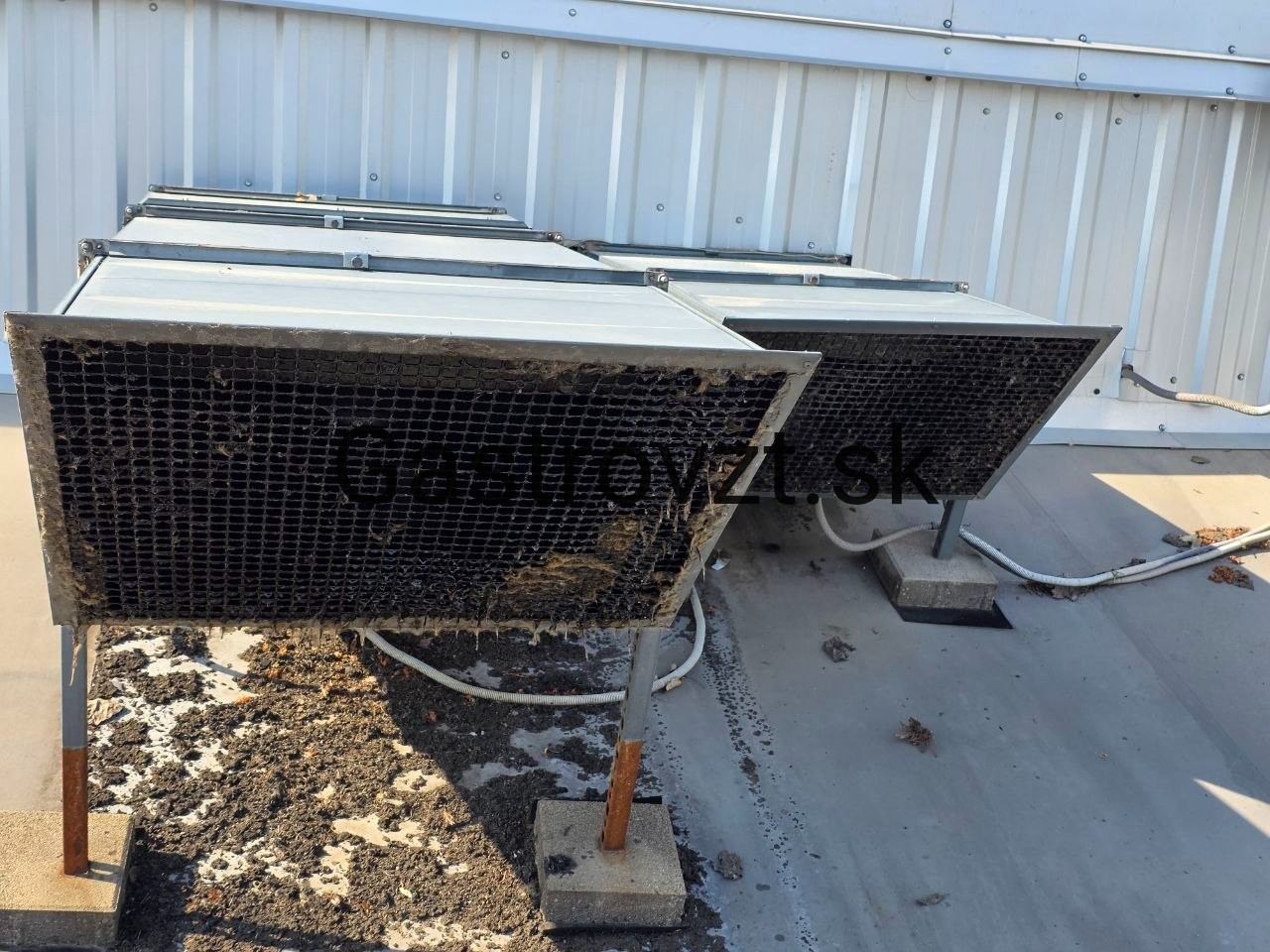
A real case. In an Italian restaurant in Trnava, two rectangular duct fans were installed on the roof. They were not intended for kitchen exhaust. Their grilles were covered with such a layer of grease that air practically couldn't get through. One no longer worked at all, the other was practically broken. I removed both and replaced them with a single kitchen fan.
Do you know the situation where replacing the fan changes nothing? This is one of the reasons — it was replaced with the same wrong type.
Mistake two: every canopy has its own fan
This mistake happens most often when buying online. The operator needs two canopies, finds a model with an integrated fan and buys two. The logic is understandable: two canopies, two motors, double the capacity.
Why it doesn't work. Two fans pulling into a shared duct can, under certain conditions, get in each other's way — each works against the pressure of the other. In kitchens where we measured it, the resulting extraction was lower than one correctly sized fan would deliver. Exactly how much is lost depends on the duct route and the characteristics of both motors, so estimating it without measurement makes no sense. On top of that, both motors are right in the kitchen, which means noise above the cooks' heads.
How it should be. One fan located outside the kitchen — on the façade or the roof — with both canopies connected to it. A motor outside the kitchen means quiet in the kitchen and maintenance access without climbing above the cooking line.
A real case. At the Pearl family restaurant in Trenčín, they had bought the hoods before I arrived, and each canopy had its own built-in fan. I didn't suggest buying everything again. We removed the fans from inside the canopies so that the canopies themselves, already paid for, could be used. Then we installed one kitchen fan on the façade and connected both hoods to it.
How to avoid these mistakes
Ask whether the equipment is intended for commercial kitchens. Not "for ventilation", but specifically for removing greasy air from a kitchen. The seller must be able to answer that.
Don't buy equipment before you know what the whole system will look like. Canopy, fan, ductwork and supply air are one system. Buying one part separately means guessing whether it will fit the rest.
Plan for supply air. Even a correctly chosen fan achieves a fraction of its capacity if replacement air has no way into the kitchen.
The fan belongs outside the kitchen. On the façade or the roof. In the kitchen it makes noise and the staff then switch it off.
What to do if you've already bought it
It doesn't always mean a loss. With canopies, the canopy itself can often be kept and only the unsuitable fan removed. With ductwork, the route can be kept and only the sections that don't fit replaced.
It's always worth a look before anything gets thrown away.
Questions and answers
How do I tell a kitchen fan from an ordinary duct fan?
By the manufacturer's stated purpose. A kitchen fan is described as intended for exhaust from professional kitchens and has cleaning access. If the description doesn't say so, it is probably an ordinary ventilation fan.
I bought canopies with integrated fans. Do I have to throw them away?
Not necessarily. In a number of cases the fan can be removed from the canopy and the canopy itself used further.
Why should the fan be outside the kitchen?
Because of noise and maintenance. A motor above the cooking line can be heard and is hard to clean.
Will a stronger fan help when extraction doesn't pull?
Mostly not. If the cause is the type of equipment, fouling or missing supply air, a stronger motor just drones more and uses more.
Do you prepare design documentation?
No. I do calculations, an engineering assessment of capacity and airflow, and a proposed solution. If licensed design documentation is needed for planning permission, I can coordinate it with the relevant specialist.
Related: kitchen extraction · kitchen ventilation · motor output is not system output.
Choose the right fan