26/08/2026 · 3 min read
Is the kitchen door hard to open? You have negative pressure, and it's costing you money
Negative pressure in a commercial kitchen reduces extraction, makes gas appliances burn worse and pulls smells from the toilets. How to recognise it and fix it.
There is a simple test of your ventilation that needs no instruments. Switch the extraction to full and try to open the kitchen door.
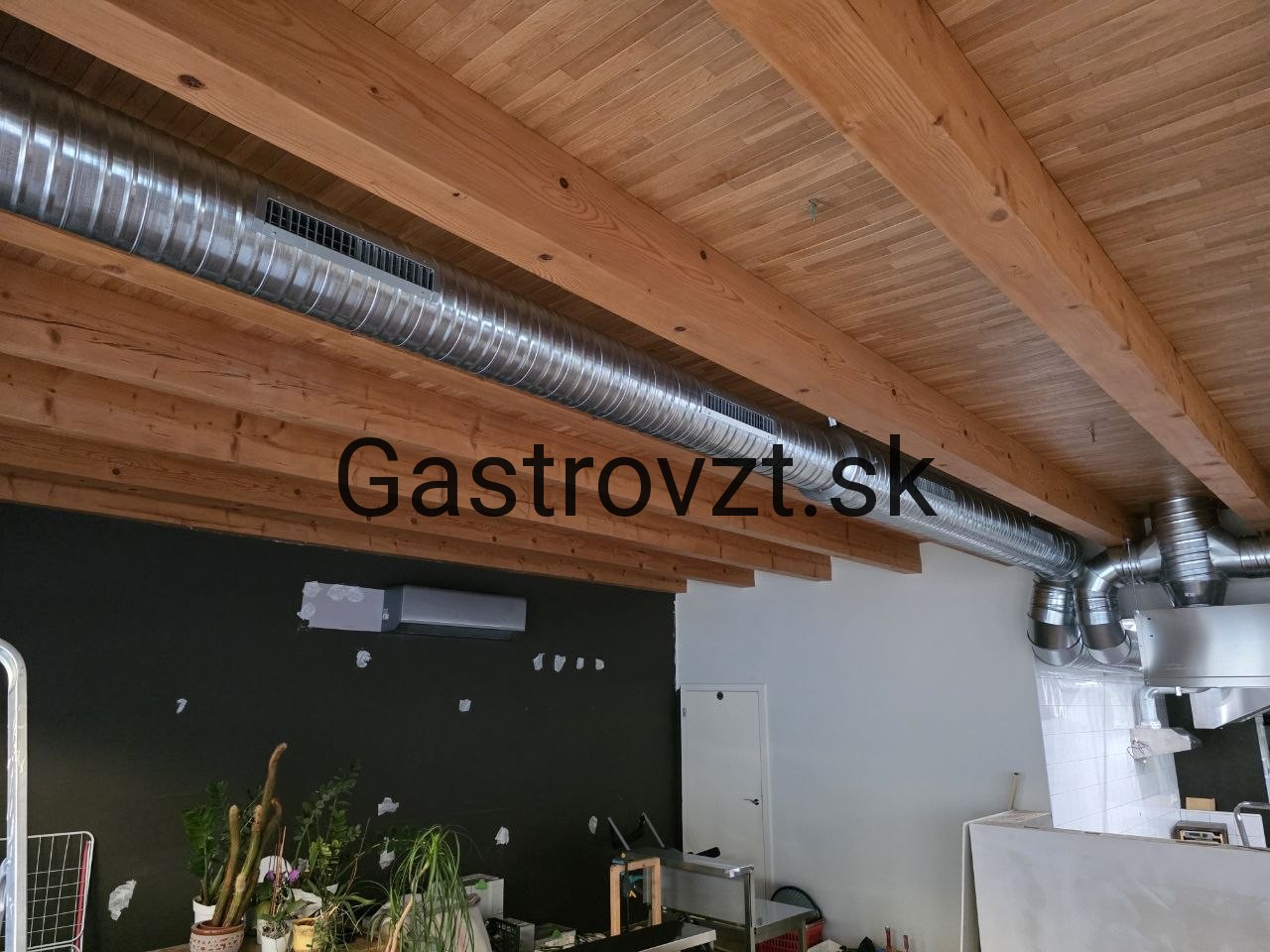
The whole project is in our references.
If it is hard to open, gets sucked shut, or you hear a hiss when opening it, your kitchen is under negative pressure.
What negative pressure is and where it comes from
Extraction removes air to the outside. The same volume of air has to get back into the kitchen from somewhere. If you have no supply unit, the air finds its own way: through gaps around doors, through drains, through shafts.
A pressure difference relative to the surroundings builds up. That is negative pressure.
A small negative pressure is desirable. The kitchen should be at a slight negative pressure relative to the dining room so that smells don't travel to the guests. That is why supply is designed at 85 to 90 percent of the extracted volume.
The problem starts when there is no supply at all.
How excessive negative pressure shows
Extraction drops. The fan has to overcome the pressure difference and its actual output falls far below the rated value. You paid for 4,000 m³/h and you get half.
Doors are hard to open. With stronger negative pressure, doors literally get sucked shut.
Gas appliances burn worse. A flame needs oxygen. Without enough air it burns incompletely, which means lower output and a risk of carbon monoxide.
Smells are pulled from toilets and drains. Air is drawn in wherever it can. If the weakest point is the waste shaft, you will smell what's in it.
Draughts on the staff. Air rushes through gaps at high speed. Cooks standing near the door feel it as a cold stream.
Higher heating costs. Nobody heats the air drawn in from outside through gaps.
Why it happens so often
During installation, extraction is visible and easy to understand. The customer wants a hood, the contractor installs a hood. The supply unit is another cost that is easy to cross out of the quote, because "it'll pull anyway".
The result is a system that has the capacity on paper but never reaches it in operation.
How it is fixed
- 1. We measure the actual extract airflow and the pressure difference between the kitchen and the dining room.
- 2. We recalculate the required supply air volume based on the current extraction.
- 3. We design the supply unit and the way air is brought into the kitchen so that it doesn't blow straight at the cooks or disturb the airflow under the hood.
- 4. We consider heat recovery. If you are adding supply anyway, it is worth checking whether recovering heat from the exhaust air pays off.
Adding supply is work that can be done without replacing the existing extraction.
Questions and answers
Can I just leave a window ajar instead of a supply unit?
No. A window doesn't let in the required amount of air; in winter it blows a cold stream straight at the staff and in summer a hot one. It is also a hygiene problem.
How can I tell whether I have negative pressure without a technician?
Try opening the kitchen door with the extraction at full. If it is hard to open, or extraction visibly improves when you leave the door open, you have negative pressure.
Does the supply air have to be heated?
In our winters, yes. Cold air blown into the kitchen is unbearable for staff, and they will switch the system off anyway.
What exactly do you do?
Calculations and engineering, i.e. calculating the required capacity and airflow, sizing and designing the solution, then supply, installation and service. We do not produce licensed design documentation for planning permission, but we can coordinate it with a specialist.
Related: kitchen ventilation · kitchen extraction · why a kitchen also needs supply air.
Balance extract and supply air