26/08/2026 · 4 min read
Glossary of kitchen ventilation terms — what the words in a quote mean
Explanations of terms you will meet when kitchen ventilation is designed: airflow, negative pressure, canopy, grease filter, heat recovery, spiral duct, silencer and more.
You receive a quote with ten terms that mean nothing to you. Here they are in plain language, in the order you'll come across them during design.
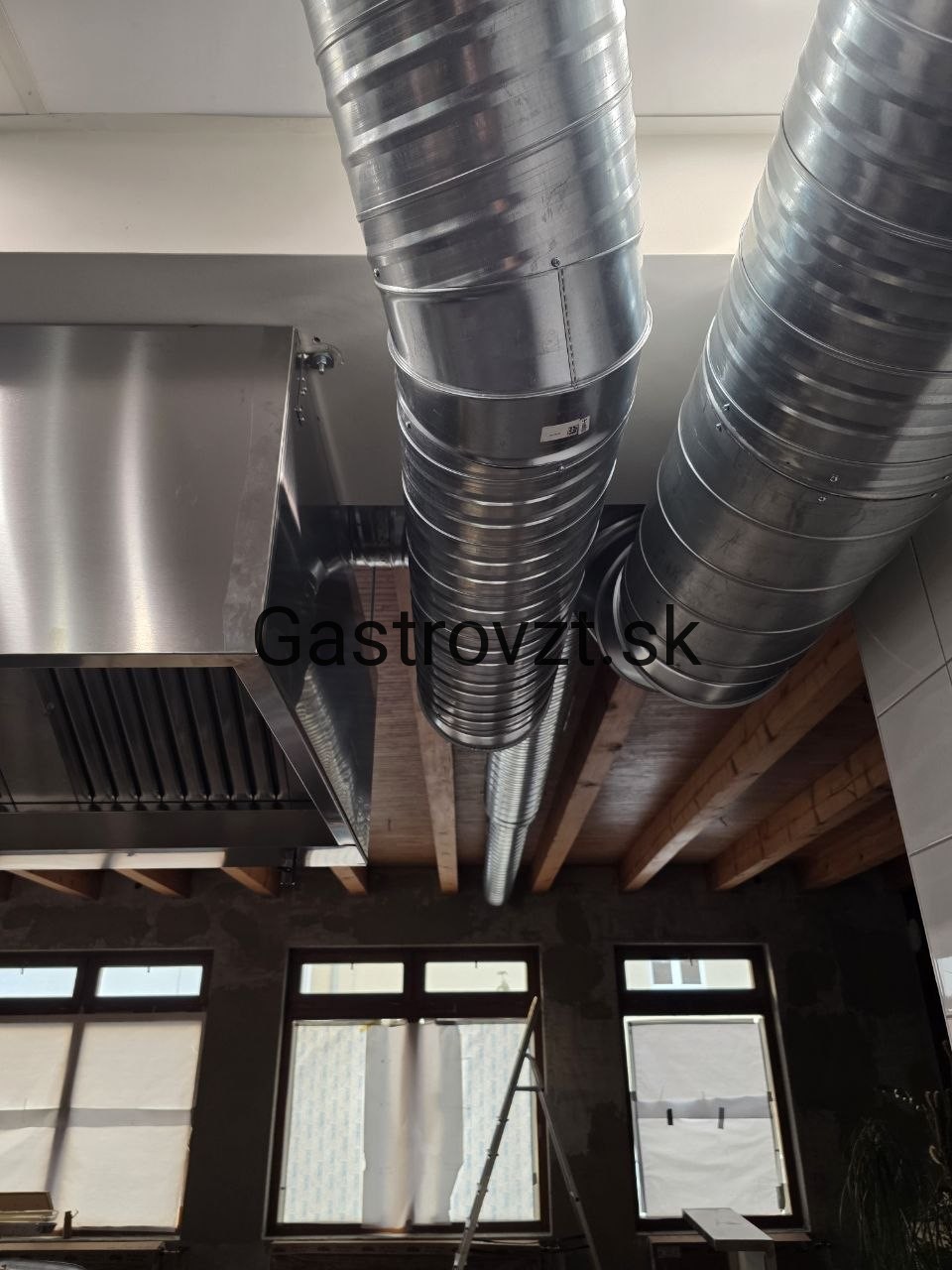
The whole project is in our references.
Airflow
The amount of air the system moves per hour. Given in m³/h (cubic metres per hour). A typical restaurant kitchen needs 2,000 to 6,000 m³/h depending on size and appliances.
Watch the difference between the rated and the actual value. A fan rated at 4,000 m³/h delivers that only at zero resistance. In a real run with ductwork and filters it delivers less.
Extraction (exhaust)
Removing polluted air from the kitchen to the outside. What most people call "ventilation".
Supply (make-up air)
Bringing fresh air into the kitchen to replace what was extracted. Without supply, extraction doesn't work even if it is installed correctly.
Negative and positive pressure
The pressure difference between two spaces. The kitchen should be at a slight negative pressure relative to the dining room, so that air flows from the dining room into the kitchen and smells don't travel to the guests.
Excessive negative pressure occurs when more air is extracted than supplied. It shows up as doors that are hard to open and weak extraction.
Canopy (hood)
The structure above the cooking line that captures rising steam and heat. In commercial kitchens it is made of stainless steel.
It comes as a wall canopy (against the wall), island canopy (hanging freely) and induction canopy (with air supplied into the canopy itself).
Grease filter
A removable insert in the canopy that catches grease particles before they reach the duct. It is washed regularly, daily in heavy use.
A neglected filter means grease in the duct, and grease in the duct is a fire hazard.
Rectangular and spiral duct
The two basic duct shapes.
Spiral duct is round duct made of spirally wound sheet metal. It has better flow and less resistance.
Rectangular duct suits places with little height, for example in a suspended ceiling.
Pressure loss
The resistance air has to overcome when passing through ducts, bends and filters. Every bend, every metre of duct and every filter takes away capacity.
That is why it pays to keep the route as short as possible with a minimum of bends.
Frequency inverter (speed control)
A device that changes the fan speed as needed. When less cooking is going on, the system runs slower.
Fan power falls with the cube of the speed, so reducing the speed to 70 percent cuts consumption to roughly a third.
Heat recovery
Taking heat from the extracted air and using it to preheat the supply air. It saves heating costs in winter.
In a kitchen it is more demanding than in an office, because the exhaust air contains grease. The exchanger must be accessible for cleaning.
Silencer
An insert in the duct that reduces fan noise. Without it, staff switch the extraction off so they can talk in the kitchen.
Access doors
Openings in the duct through which the system can be cleaned. Without them the duct can't be cleaned and grease accumulates in it for years.
Check that they exist when you take over the work.
Ventilated ceiling
A solution where the whole ceiling surface above the kitchen takes over the canopy's function. Nothing hangs above the cooking line. It requires sufficient height and work on the structure.
Air changes per hour
How many times per hour the whole volume of air in a room is replaced. A typical restaurant kitchen has 25 to 40 air changes, a kitchen with fryers and a grill as many as 60.
Diversity of use
The fact that you don't cook on all appliances at once. The system is sized for real simultaneous use, not for the sum of all rated power inputs. This is where the biggest savings come from.
STN EN 16282
The European standard for ventilation of commercial kitchens, also adopted in Slovakia. It sets the method for calculating the required air volume and the requirements for canopies, ventilated ceilings, ducts and separators.
Calculations and engineering
Calculating the required extract and supply capacity, sizing the ducts and laying out the equipment. This differs from producing design documentation under the Building Act, which is done by licensed designers.
Questions and answers
What does m³/h mean in a quote?
Cubic metres per hour, i.e. the amount of air the system moves. The higher the number, the more powerful the system and the higher the consumption.
Why does the quote include a supply unit when I only need extraction?
Without fresh air supply, extraction won't reach its stated capacity. Negative pressure builds up and the system extracts a fraction of what you paid for.
Is heat recovery mandatory?
That depends on the type and size of the building and is assessed by the building's designer. In terms of cost, it usually pays off in a kitchen with long operating hours.
Related: ventilation for restaurants · kitchen ventilation · how much air a kitchen needs.
Get a free site visit