26/08/2026 · 3 min read
Ventilation for school and staff canteens: zoned ventilation and savings
Canteens cook in bursts and spend their operator's money. How to design ventilation that handles the peak without wasting energy outside it.
A school or staff canteen runs in a way you won't find in a restaurant. Cooking happens in the morning, serving lasts an hour and a half, then there's washing up and silence.
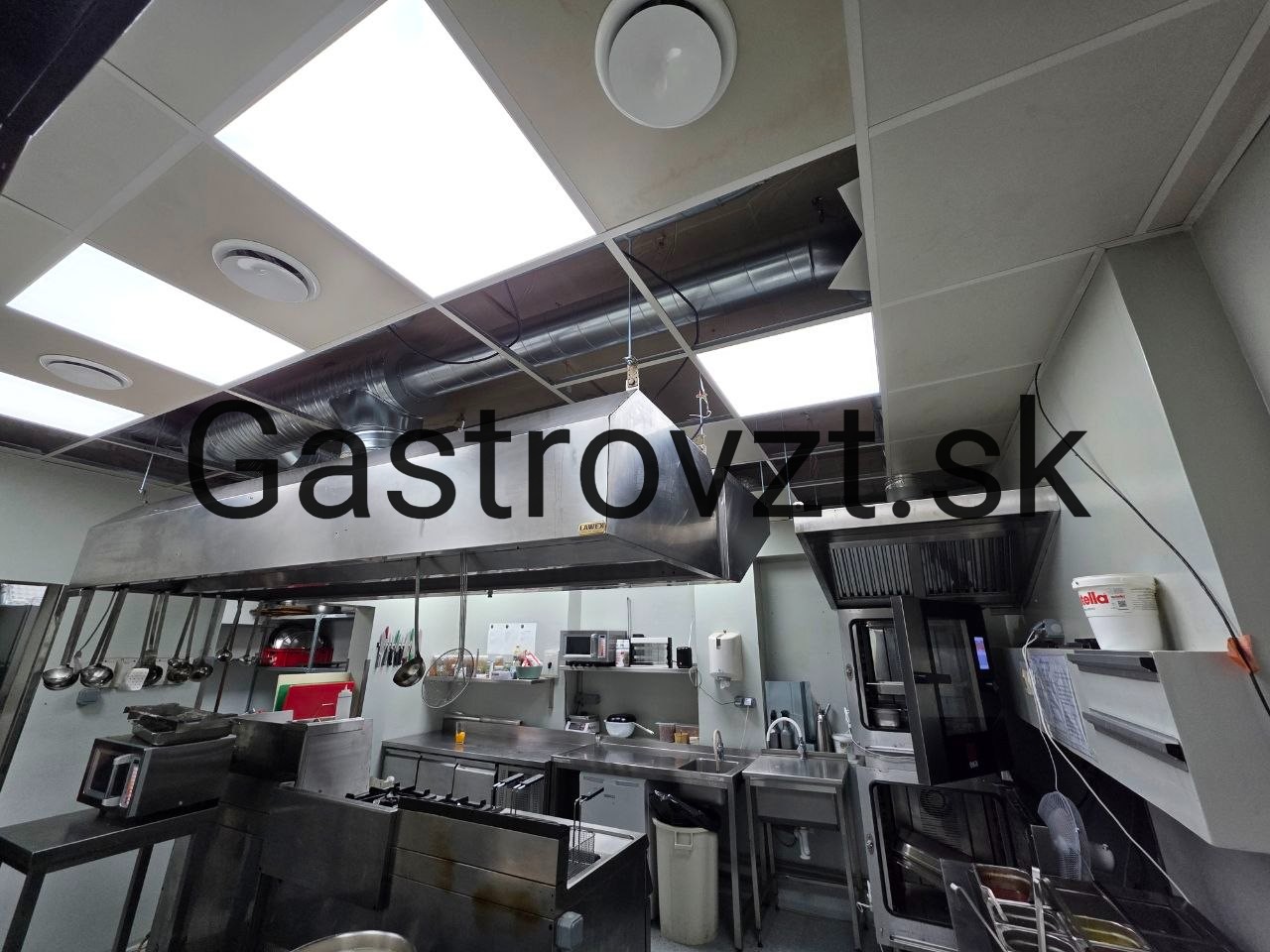
The whole project is in our references.
A system designed as if for a restaurant runs at full capacity for far too long here, and the operator pays the energy bill.
What's different about a canteen
A short, intense peak. Boiling pans and combi ovens all run at once during the morning. The system has to handle full load, but only for a few hours a day.
Large volumes, few dishes. Instead of twenty appliances, a few large boiling pans. The heat load is concentrated in one place.
Washing up after serving. The commercial dishwasher runs once cooking is finished. If the ventilation is switched off after cooking, steam from the dishwasher stays in the room.
The dining hall fills up all at once. A hundred people in one room for forty minutes is a different load on dining-room ventilation than guests arriving gradually in a restaurant.
The budget is public. Running costs are monitored and must be justified. A system that eats electricity outside operating hours is a problem.
Zoned ventilation
The solution that makes the most sense in canteens. Instead of one system running at full capacity, the space is divided into zones with their own control.
- The cooking zone runs at full during preparation, then turns down.
- The washing zone ramps up when washing starts.
- The dining hall runs at full capacity during serving and at minimum otherwise.
In practice this means the system runs at full power for two or three hours a day instead of eight.
Why it's worth doing the maths
Fan power falls with the cube of the speed. Reducing speed to 70 percent cuts consumption to roughly a third.
For a canteen running five days a week, ten months a year, the difference shows clearly in the annual electricity bill. Variable speed control usually pays for itself within a few years.
Heat recovery in a canteen
A canteen removes large amounts of warm air in a short time, during the heating season. That is a situation where heat recovery makes sense.
In a commercial kitchen it is more demanding than in an office, because the exhaust air contains grease and the exchanger must be cleanable. This is solved with upstream separators and an accessible exchanger.
What tends to go wrong in older canteens
Most school canteens in Slovakia have a system dating from when the building was built. Typical findings:
- fans without any control at all, either on or off
- no controlled air supply, only extraction
- ductwork not cleaned for decades
- canopies that don't match the current kitchen equipment because the boiling pans have since been replaced
In most cases the existing route can be refurbished and a complete replacement isn't necessary.
Questions and answers
Can control be added to an existing system?
In most cases, yes. A frequency inverter can be added without replacing the fan, provided the fan is in good condition.
Does the canteen have to close for the refurbishment?
The work can be scheduled for school holidays or non-operating days. For staff canteens, at weekends.
How often should canteen ventilation be cleaned?
Depending on load, usually twice a year. More often with large volumes of frying. Our service covers cleaning of kitchen fans and of filters on supply units; cleaning the duct itself is a separate specialism.
Do you prepare design documentation for public procurement?
No. We do calculations and engineering assessment, design the solution, supply, install and service it. If licensed design documentation is needed for procurement, we can coordinate it with the relevant specialist.
Related: heat recovery for restaurants · kitchen ventilation · variable speed control and energy savings.
Design ventilation for your canteen